
One-line definition: A parcel locker is an automated, self-service cabinet where carriers deposit parcels for recipients to collect at their own convenience, using a code or app notification.
What it means
A parcel locker is a secure, unmanned cabinet — typically found at supermarkets, petrol stations, transport hubs, and residential areas — where a carrier deposits a parcel instead of delivering it to a home address. When the parcel arrives, the recipient gets a notification (by SMS, email, or app) with a code or QR code. They go to the locker at any time, enter their code, and collect their parcel from the assigned compartment.
No staff interaction is required. No waiting at home for a delivery driver. No missed delivery cards. The parcel waits in the locker — typically for 7 to 14 days — until the customer is ready to collect.
Why it matters for e-commerce merchants
Parcel lockers are not a niche delivery option in the markets Packrooster serves — they are the dominant delivery preference. In Finland and Estonia, the majority of B2C e-commerce parcels are delivered to lockers rather than home addresses. In Sweden, Latvia, and Lithuania, locker adoption is high and growing. In Denmark and Norway, service point and locker networks are a core part of how consumers expect to receive online orders.
For any Shopify merchant selling to customers in these markets, the practical implication is direct: if you do not offer parcel locker delivery at checkout, a meaningful share of your potential customers will not complete their purchase, or will not return after their first order. Locker delivery is not a secondary option in these markets — it is the expected default for many consumer segments.
Beyond the conversion argument, parcel lockers solve the most persistent operational problem in last mile delivery — the failed first attempt. Home delivery requires the recipient to be present. Locker delivery does not. The carrier makes one stop at the locker, deposits the parcel, and moves on. There is no redelivery cost, no missed delivery card, no customer service contact asking where the parcel is. For merchants, that translates directly into fewer support contacts and lower overall shipping costs per successfully delivered order.
How parcel lockers work
The mechanics are straightforward but worth understanding in detail, because each carrier network operates its own lockers and they are not interchangeable.
1. Label creation. When a merchant books a shipment with locker delivery, the customer's chosen locker is encoded into the shipping label. The label specifies not just the carrier but the specific locker location and compartment type (size).
2. Carrier deposit. The carrier's driver arrives at the locker bank, scans the parcel, and the locker system assigns an available compartment of the right size. The parcel is placed inside and the compartment locks automatically.
3. Customer notification. The recipient receives a notification — typically by SMS and/or email — with a pickup code or a QR code that opens their specific compartment.
4. Collection. The customer goes to the locker at any time within the holding period, enters their code or scans their QR, and the compartment opens. The parcel is theirs.
5. Non-collection. If the parcel is not collected within the holding period (usually 7–14 days depending on the carrier), it is returned to the sender. The return generates a shipping cost.
Locker size limits
Every locker bank contains compartments of different sizes. Standard locker compartments have maximum dimensions — typically around 41 × 38 × 64 cm for a large cell, smaller for standard and small cells. Parcels that exceed the largest available compartment size cannot be delivered to a locker and must go to a service point or home delivery instead.
This is an important operational detail for merchants whose products are large or bulky. Showing locker delivery as an option at checkout for an oversized parcel — and then having the carrier fail to fit it in a locker — creates a poor customer experience and a redelivery problem. The correct approach is to hide locker options at checkout for orders above a certain size or weight threshold.
The major locker networks by market
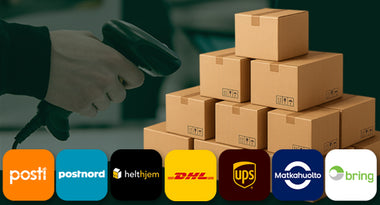
Parcel locker networks are carrier-specific and not interchangeable. A parcel booked with Posti cannot be collected from an Omniva locker, and vice versa. The carrier whose label is on the parcel determines which locker network the customer can use.
| Market | Key locker networks |
|---|---|
| Finland | Posti, PostNord, Matkahuolto |
| Estonia | Omniva, Posti SmartPOST |
| Latvia | Omniva |
| Lithuania | Omniva |
| Sweden | PostNord, Instabox, Budbee Box |
| Norway | Bring (pickup points), PostNord |
| Denmark | PostNord |
| UK | InPost |
| Germany | DHL Packstation, InPost |
Network density varies significantly by country and region. Urban areas typically have locker banks within 1–2 km of most addresses. Rural areas may have lockers only in the nearest town or service hub. This is why showing customers the nearest available locker at checkout — rather than a list of all lockers in the country — is important for conversion. A locker 30 km away is not a useful delivery option for most customers.
Common misconceptions and mistakes
"Parcel lockers and service points are the same thing." They are not. A parcel locker is unmanned and automated — open 24 hours, no staff. A service point is a staffed retail location — a supermarket or newsagent — where staff hold parcels behind a counter. Both are PUDO points, but the customer experience is different. Lockers are faster (no queue, no ID check) and available outside retail hours. Service points have staff who can handle issues on the spot.
"Any carrier can deliver to any locker." Locker networks are closed ecosystems. DHL cannot deliver to a Posti locker. PostNord cannot deliver to an Omniva locker. The carrier and the locker network must match. Showing the wrong locker network at checkout for a given carrier creates an undeliverable order. There are also companies that have general lockers that more than one carrier uses.
"Locker delivery is only for small items." Standard locker compartments accommodate most consumer parcel sizes — clothing, electronics, books, accessories. The constraint is oversized items. For a typical Shopify store, the majority of products will fit within standard locker compartment dimensions.
"Customers always prefer home delivery." In Nordic and Baltic markets, this assumption is demonstrably wrong. Consumer surveys and carrier volume data consistently show locker and service point collection outpacing home delivery for B2C e-commerce in Finland, Estonia, Latvia, and Lithuania. Defaulting to home delivery only because it feels like the primary option misreads the market.
How this connects to your Shopify store
Packrooster's dynamic pickup point feature integrates carrier locker networks directly into your Shopify checkout. When a customer enters their delivery address, Packrooster shows them the nearest available locker locations for the relevant carrier — automatically, based on their location and the content in their order.
This means a Finnish customer sees nearby Posti lockers. An Estonian customer sees Omniva locations. A Swedish customer sees PostNord or Instabox options. The right locker network for the right market, without you configuring location lists manually for each carrier and country.
Packrooster also supports rules that control when locker options are shown or hidden. If a parcel exceeds the maximum locker compartment size, locker delivery can be suppressed automatically at checkout so customers are never offered a delivery option that won't work for their specific order. This prevents the failed delivery problem that arises when oversized parcels are booked to lockers without size validation. You can also choose to hide outside parcel lockers. This can be especially important for merchants that sells items that can freeze in the winter.
On the returns side, many of the same locker networks that deliver parcels also accept return drop-offs. A customer who collected their order from an Omniva locker can return it using a Packrooster-generated return label by dropping it off at the same location — no separate arrangements needed.
Learn more about Packrooster's pickup point features →
Frequently asked questions
What happens if my parcel doesn't fit in a locker? If no locker compartment of the right size is available at the customer's chosen location at the time of delivery, the carrier typically redirects the parcel to the nearest service point or attempts home delivery instead. This is handled by the carrier automatically in most cases, but it means the customer receives the parcel at a different location than they chose — which can cause confusion. Right-sizing your packaging and hiding locker options for oversized orders at checkout reduces this occurrence significantly.
How long does a parcel wait in a locker before it is returned? Holding periods vary by carrier and market — typically 7 to 14 days. Posti holds parcels for 7 days. Omniva holds for 7 days. PostNord varies by market but is generally 7–10 days. After the holding period, uncollected parcels are returned to the sender at the sender's cost. Sending customers a collection reminder as the deadline approaches reduces non-collection rates.
Can I offer multiple locker networks at checkout for the same market? Yes, if you have carrier accounts with multiple carriers operating locker networks in that market. In Sweden, for example, you could offer both PostNord parcel lockers and Instabox lockers as checkout options, each routing to the respective carrier's network. Packrooster manages the carrier-locker relationship on each option so customers are shown the correct network for their chosen service.
Are parcel lockers available in rural areas? Coverage varies significantly by carrier and country. In Finland and Estonia, Posti and Omniva have invested in locker coverage beyond major urban centers, including smaller towns and some rural service points. In Sweden, PostNord's locker coverage is concentrated in urban and suburban areas. For rural customers, a service point or home delivery option is often a more reliable fallback than a locker. Packrooster's checkout rules let you configure service point options as alternatives when locker coverage is thin for a given postcode.
Do parcel lockers work for returns as well as deliveries? Many locker networks support both directions. A customer can use the same locker bank to drop off a return as to collect a delivery — using a return label generated by the merchant. Omniva, Posti, PostNord, and InPost all support return drop-off at their locker and service point locations. This makes locker networks a practical infrastructure for the full delivery and return cycle, not just the outbound leg.