
Denmark is one of Scandinavia's most active e-commerce markets and, by geography, one of its most naturally connected to the rest of Europe. Sharing a land border with Germany and positioned at the gateway between Scandinavia and continental Europe, Danish merchants can reach the EU's largest consumer markets faster than almost any other Nordic country. Add full EU membership — no customs friction to most of your key export destinations — and Denmark is a genuinely strong base for cross-border e-commerce.
This guide covers the carriers Danish e-commerce merchants rely on, realistic pricing benchmarks, how customs works for non-EU destinations, packaging requirements, and how to run a lean fulfillment operation from your Shopify store.
What makes shipping from Denmark distinctive
Denmark's position in European logistics is unusually advantageous. The Øresund Bridge connects Copenhagen directly to Malmö and the Swedish rail and road network. The southern land border with Germany puts the continent's largest economy within a few hours' drive. And Denmark's island geography — the Jutland peninsula, Zealand, Funen, Bornholm, and the Faroe Islands — means the domestic carrier network has had to solve real distribution challenges, producing a reliable and well-developed infrastructure for the home market.
For e-commerce merchants, the EU membership is the defining advantage. Shipping from Copenhagen to Berlin, Amsterdam, or Paris carries no customs requirements and no duties on standard goods. PostNord, DHL, GLS, and DB Schenker all operate competitive cross-border services on the Denmark–Germany corridor specifically — one of the highest-volume freight routes in northern Europe.
The main complexity for Danish merchants is the Scandinavian dimension. Norway is close and a natural market, but it sits outside the EU Customs Union — meaning every commercial shipment to Norway requires customs documentation. The same applies to the UK post-Brexit. These are the two most common compliance gaps for Danish e-commerce merchants expanding internationally.
Denmark also has a well-developed pickup point culture. PostNord's service point and parcel locker network covers the country extensively, and Danish consumers expect delivery flexibility — particularly the option to collect from a nearby service point rather than wait at home. Getting this right at checkout is important for conversion.
Carriers Danish e-commerce merchants rely on
PostNord (Denmark)
PostNord is the dominant carrier for domestic Danish e-commerce and the natural starting point for most Shopify merchants. As the national postal operator's Nordic parcel network, PostNord covers Denmark comprehensively with a service point and parcel locker network that gives Danish consumers strong pickup flexibility.
PostNord Denmark's services in Packrooster include PostNord Parcel (door delivery), Service Point and Parcel Locker for pickup (previously MyPack Collect), PostNord Home (home delivery with a delivery window), PostNord Pallet for larger shipments, Groupage for freight volumes, and International Parcel for cross-border EU shipping.
Best for: Domestic Danish e-commerce across all delivery types, Nordic cross-border shipping, stores where pickup point delivery is important for customer conversion. Watch out for: PostNord's domestic network is excellent, but for international shipping outside the Nordics, compare against DHL and GLS — they often offer more competitive pricing and faster transit to central European destinations.
DHL Express
DHL's premium courier service is well-established in Denmark and the right choice for international shipments where speed matters most. DHL Economy Select, Express Worldwide, and Express EU services cover major European lanes in 1–2 days and most global destinations in 2–4 days.
Best for: Time-sensitive international shipments, high-value goods, business parcels where delivery certainty is the priority, shipments to markets outside the Nordics and EU. Watch out for: DHL Express is a premium-priced product. Reserve it for shipments where speed justifies the cost — for standard B2C EU parcels, DHL eCommerce is more economical.
DHL eCommerce (Parcel Connect)
DHL eCommerce's Parcel Connect service is designed specifically for cross-border e-commerce within Europe. DHL Parcel Connect and Parcel Connect Plus provide economical EU-wide delivery at lower price points than DHL Express, with solid tracking and transit times of 3–5 days to most EU destinations. DHL Parcel International extends this to non-EU markets.
Best for: Cost-conscious EU cross-border e-commerce, merchants shipping regular volumes to multiple EU markets, the economical DHL option for everyday B2C parcels. Watch out for: Slower than DHL Express. For customers expecting 1–2 day delivery, DHL Express is the right product. Parcel Connect is for routes where 3–5 days is acceptable and price matters.
GLS Denmark
GLS (General Logistics Systems) has a strong Danish presence and is one of the most widely used carriers for cross-border EU e-commerce among Danish merchants — particularly for shipments to Germany, the Netherlands, Poland, and central Europe, where GLS's network density is high.
Best for: EU cross-border parcel shipping especially to Germany and central Europe, merchants looking for a cost-competitive alternative to DHL on high-volume EU routes. Watch out for: GLS coverage and transit time performance varies by destination country. Strong in Germany and central Europe; check density and delivery times for specific markets you're targeting.
DB Schenker
DB Schenker's Danish operations cover both parcel and freight, and the carrier is particularly strong for B2B shipments and larger or heavier consignments. Schenker's pan-European network makes it a solid choice for merchants who regularly ship to Germany, France, and central Europe at scale.
Best for: B2B shipments, freight volumes, heavier parcels, merchants shipping regularly to Germany and central Europe where Schenker's network is strongest. Watch out for: Schenker's pricing is most competitive for regular volume shippers. Occasional senders will often find PostNord or DHL more convenient for standard parcels.
Bring
Bring (the commercial brand of Norway Post / Posten Norge) operates in Denmark and is the primary carrier for cross-Nordic shipping, including the Denmark–Norway corridor. While PostNord handles most domestic Danish volume, Bring is worth having for merchants with significant Norwegian customer bases — Bring's Norwegian delivery network is the country's most extensive, and routing Denmark-to-Norway shipments via Bring can provide better last-mile coverage than alternatives.
Best for: Shipments to Norway, merchants with a significant Norwegian customer base, Nordic cross-border logistics where Bring's Norwegian network depth matters. Watch out for: For domestic Danish shipping and EU destinations, PostNord and DHL will generally be more straightforward. Bring adds the most value specifically on the Norway corridor.
Deutsche Post
Deutsche Post provides international letter and packet services at competitive rates for lower-weight shipments. Their Business Mail Standard, Business Mail Registered, Packet, Packet Plus, and Packet Tracked services are available through Packrooster and are useful for lightweight goods — documents, small accessories, low-weight consumer products — where courier pricing is disproportionate to the item value.
Best for: Lightweight international shipments, documents, small accessories, merchants where product weight makes standard courier economics difficult. Watch out for: Transit times are significantly slower than courier services — typically 5–14 days internationally. Not appropriate for customers who expect fast delivery.
FedEx and UPS
Both global carriers operate in Denmark and are the standard choice for international shipments outside Europe — North America, Asia-Pacific, and markets where global carrier reach is required. FedEx International Priority, Economy, and Connect Plus, and UPS Standard, Expedited, and Express, cover major global lanes reliably.
Best for: International shipments outside Europe, high-value business parcels, global routes where PostNord's or DHL's international pricing is less competitive. Watch out for: List prices are high relative to negotiated or volume rates. These carriers deliver their best value on international shipments where speed and reliability justify the premium cost.
Pricing and typical transit times
The table below gives you realistic ballpark figures for standard parcels shipped from Denmark at approximate list or near-list rates. Prices are in DKK. Actual costs depend on volumetric weight, your carrier contract, and fuel surcharges.
| Route | Weight | Carrier | Est. price | Transit time |
|---|---|---|---|---|
| Denmark → Denmark (domestic) | Up to 2 kg | PostNord | DKK 45–75 | Next day |
| Denmark → Denmark (domestic) | Up to 10 kg | PostNord | DKK 80–140 | 1–2 days |
| Denmark → Sweden | Up to 5 kg | PostNord / DHL | DKK 100–180 | 1–2 days |
| Denmark → Norway | Up to 5 kg | PostNord / Bring | DKK 130–220 | 2–3 days |
| Denmark → Germany | Up to 5 kg | GLS / DHL eCommerce | DKK 100–175 | 2–3 days |
| Denmark → Netherlands | Up to 5 kg | GLS / DHL eCommerce | DKK 110–185 | 2–4 days |
| Denmark → UK | Up to 5 kg | DHL Express / FedEx | DKK 200–340 | 2–4 days |
| Denmark → USA | Up to 2 kg | FedEx / DHL Express | DKK 380–640 | 3–5 days |
| Denmark → USA | Up to 2 kg | Deutsche Post (Packet) | DKK 120–190 | 10–18 days |
Note: These are indicative list-rate estimates as of early 2025 in DKK. Customs duties, VAT, and brokerage fees are not included where applicable. Always verify current rates directly with your carrier before quoting customers.
Volumetric weight
All major carriers charge based on the greater of actual weight or volumetric weight:
Volumetric weight (kg) = (Length × Width × Height in cm) ÷ 5000
A light but bulky parcel — padded clothing, pillows, packaging with excess air space — will be priced on volumetric weight. For international routes especially, compact packing directly reduces your shipping cost. Review your box sizes and fill material if you regularly ship lighter goods in larger boxes.
Customs, duties, and regulations
Shipping within the EU
Denmark is a full EU member, so shipping to any other EU country — Germany, Sweden, Finland, France, the Netherlands, the Baltics — requires no customs declarations and carries no duties on standard goods. Your carrier booking asks for contents and value for their records, but there are no border checks or clearance delays on standard EU parcels.
One notable exception is Greenland and the Faroe Islands. Although both are Danish territories, neither is part of the EU. Shipments from mainland Denmark to Greenland or the Faroe Islands cross a customs boundary and require customs documentation. For merchants who sell to customers in these territories, treat them as non-EU destinations.
Excise goods — alcohol, tobacco — have specific intra-EU handling rules. Check carrier restrictions before shipping these, even to EU destinations.
Shipping to Norway
Norway is Denmark's most commercially important non-EU neighbor, and the customs requirement is the most common compliance gap for Danish merchants expanding northward. Despite close geographic and cultural ties, Norway is outside the EU Customs Union — every commercial shipment requires:
- CN22 for parcels with a goods value under €300
- CN23 for parcels with a goods value over €300 or any commercial goods via courier
- Commercial invoice — value, HS tariff code, description, country of origin
- Norwegian import VAT (25%) applies on purchases over NOK 350 (approximately DKK 245)
For Danish merchants regularly shipping to Norwegian consumers, VOEC (Value Added Tax On E-Commerce) registration simplifies the VAT handling significantly — you collect and remit Norwegian VAT at checkout rather than the customer facing import VAT charges at delivery. Packrooster supports VOEC and other customs ID assignment.
Shipping to the UK
Post-Brexit, the UK operates as a third country for EU customs purposes. Every shipment from Denmark to the UK requires:
- CN23 customs declaration for commercial goods
- Commercial invoice — value, HS tariff code, description, country of origin
- UK import VAT on goods above £135 in value
For orders under £135, UK import VAT is collected at point of sale and remitted by the seller — this requires UK VAT registration. Orders above £135 have VAT collected at UK import. Build in 1–3 additional days for UK customs processing. Correct HS codes are the most common determining factor in whether shipments clear smoothly or get held.
Shipping to the USA and globally
US import duties apply based on HS code. CN22 for parcels under €300, CN23 for higher-value or commercial goods. For courier shipments, the carrier's customs brokerage handles clearance — factor in potential brokerage fees for higher-value shipments.
Required documentation summary for non-EU shipments
- CN22 — parcels under €300 in value (most postal services)
- CN23 — parcels over €300 or any commercial goods via courier
- Commercial invoice — 3 copies, stating value, HS tariff code, country of origin
- EORI number — required for commercial cross-border shipping from Denmark. Format: DK + your Danish CVR number
Packrooster generates customs documents automatically for international shipments with the correct carrier-specific and country-specific formatting, and supports electronic/paperless trade where carriers accept it.
Prohibited and restricted items
Standard carrier prohibitions apply: dangerous goods (lithium batteries in certain configurations, flammable liquids, compressed gases), counterfeit goods, live animals without CITES documentation, cash, firearms, and controlled substances. Lithium batteries in consumer electronics are the most commonly mishandled — declare them explicitly in item descriptions and check your specific carrier's battery policy before booking international shipments.
Packaging requirements and tips
Danish consumers have high expectations around packaging quality — unboxing experience matters, and carrier damage liability assessments factor packaging into claim decisions. The same five fundamentals apply:
1. Use structurally sound boxes. New or near-new boxes for anything valuable. Reused boxes that have previously been compressed or retaped are structurally weaker than they appear.
2. Allow adequate internal protection. At least 5 cm of protective fill — bubble wrap, foam, kraft paper — between your product and box walls on all sides. Fragile and high-value items need more.
3. Seal all seams with packing tape. H-tape all joins: a strip down the centre seam and strips crossing each end. Masking tape and general-purpose tape fail under the pressure of conveyor sorting systems and in cold or damp conditions.
4. Protect the shipping label. Apply to the largest flat surface. Cover with clear tape for moisture protection, but keep tape off barcodes — taped-over barcodes cause scan failures at sorting hubs.
5. Pack for volumetric weight. The smallest box that safely protects your product is the most cost-efficient choice. Every unnecessary centimeter adds to your shipping cost on international routes.
Size and weight limits (standard parcel services):
| Carrier | Max weight | Max dimensions |
|---|---|---|
| PostNord Denmark (Parcel) | 20 kg | 100 × 60 × 60 cm |
| GLS (Euro Business Parcel) | 40 kg | 200 cm longest side |
| DHL Express | 70 kg | 120 × 80 × 80 cm |
| DHL eCommerce (Parcel Connect) | 31.5 kg | 175 cm longest side |
| Bring (Business Parcel) | 35 kg | 150 cm longest side |
| UPS Expedited | 70 kg | 270 cm longest side |
Shipments exceeding these limits move into freight territory — PostNord Pallet, DB Schenker System and Part Load, Bring Business Pallet, or dedicated freight operators for larger volumes.
How Packrooster makes this easier for Shopify stores
Danish Shopify merchants face a shipping operation that spans multiple carrier relationships, customs requirements for Norway and the UK, and consumer expectations around pickup point delivery that vary by market. Managing this across separate carrier portals — PostNord for domestic, GLS for EU, DHL for express, Bring for Norway — is a meaningful operational overhead.
Packrooster connects all your Danish carriers directly to Shopify, so the entire fulfillment workflow — label creation, customs documents, return labels, carrier selection — runs from inside your Shopify admin.
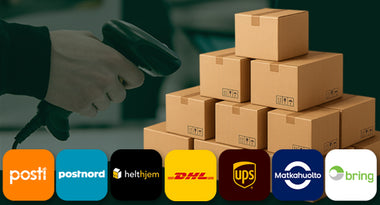
All your carriers in one place. PostNord Denmark, DHL Express, DHL eCommerce, GLS, DB Schenker, Bring, Deutsche Post, FedEx, and UPS are all supported. Connect your carrier accounts once and select the right service at fulfillment without switching between portals or systems.
Automatic customs documents. For shipments to Norway, the UK, the USA, and other non-EU destinations, Packrooster generates the required customs declarations automatically with the correct carrier-specific and country-specific format. Electronic and paperless trade is supported where carriers accept it — eliminating the manual printing and attaching of customs forms to each international parcel.
Pickup point delivery at checkout. Packrooster's dynamic pickup point feature automatically shows customers the right carrier service points and lockers based on their location. Danish customers see PostNord service points and lockers. Norwegian customers see Bring or PostNord Norway pickup options. Swedish customers see PostNord Sweden. All from the same store, configured once in Shopify.
Shipping labels and bulk fulfillment. Print labels directly from Shopify, individually or in bulk. Packrooster's scan-to-fulfill workflow lets warehouse staff scan an order barcode, validate the items being packed, and generate a shipping label in one step — reducing errors and speeding up packing during high-volume periods.
Return labels. Generate return labels automatically alongside the outbound shipment, or on demand when a customer requests a return. For Danish merchants selling to Norwegian, Swedish, and EU customers — where easy returns are a baseline expectation — having returns handled inside Shopify rather than through separate carrier portals reduces both overhead and customer support volume.
Customs VAT ID management. Packrooster supports assignment of EORI, VOEC for Norwegian VAT, IOSS for EU B2C, and HMRC registration for UK VAT — per shipping origin and destination — so the right tax identifier is applied automatically on each shipment.
Learn more about Packrooster →
Frequently asked questions
How long does standard shipping from Denmark to Germany take? With GLS or DHL eCommerce, standard parcels from Denmark to Germany typically take 2–3 business days. Denmark's land border with Germany makes it one of the fastest cross-border EU routes from Scandinavia. DHL Express can reach Germany in 1–2 days at a premium. PostNord International Parcel typically takes 3–4 days.
Do I need customs documents to ship from Denmark to Norway? Yes. Despite the geographic and cultural proximity, Norway is outside the EU Customs Union. Every commercial shipment from Denmark to Norway requires a customs declaration (CN22 or CN23), a commercial invoice, and correct HS codes. Norwegian import VAT (25%) applies on purchases over NOK 350. This is the most common compliance gap for Danish merchants expanding to the Norwegian market.
What about shipping to Greenland and the Faroe Islands from Denmark? Both are Danish territories but are outside the EU. Treat them as non-EU destinations — customs declarations are required in both directions. Carriers serving these routes have specific services for the Greenland and Faroe Island corridors. Check with your carrier for current rates and transit times, as they can vary significantly from mainland Denmark shipping.
What is the best carrier for shipping from Denmark to Germany? For most Danish Shopify merchants, GLS and DHL eCommerce are the most cost-competitive options for Germany. GLS has a strong German delivery network with dense pickup point coverage, and DHL eCommerce Parcel Connect gives you DHL's tracking and reliability at economical rates. For time-sensitive B2B shipments, DB Schenker or DHL Express are stronger options.
How does VOEC registration work for selling to Norwegian customers? VOEC (Value Added Tax on E-Commerce) is Norway's simplified VAT registration scheme for foreign e-commerce sellers. If you regularly ship orders under NOK 3,000 to Norwegian consumers, registering for VOEC lets you collect Norwegian VAT (25%) at checkout and remit it directly to Norwegian tax authorities — rather than the customer paying import VAT as a surprise charge at delivery. This significantly improves the Norwegian customer experience. Packrooster supports VOEC ID assignment on Norwegian shipments once you're registered.
What is the difference between GLS and PostNord for EU cross-border shipping? PostNord is stronger for Nordic cross-border shipping — to Sweden, Norway, and Finland specifically. GLS is stronger for central European destinations — Germany, the Netherlands, Belgium, Poland, and the Czech Republic. For a Danish merchant with customers across both regions, using both carriers and routing shipments to the carrier with the best network in each destination is often the most effective approach. Packrooster's checkout rules let you configure this routing automatically.
How do I handle UK customs for shipments from Denmark? Orders to UK customers require a CN23 customs declaration and commercial invoice. For orders under £135, you need to collect UK import VAT at checkout and remit it to HMRC — requiring UK VAT registration. For orders above £135, UK customs collects VAT at import from the recipient. Packrooster generates customs documentation automatically. UK VAT registration is a separate compliance step — consult a tax adviser if you're shipping significant volumes to UK consumers.
How do I manage returns from EU customers efficiently? For Danish Shopify merchants, Packrooster handles return label generation inside Shopify — either automatically included with the outbound shipment, or generated on demand when a customer requests a return. For high-return-rate markets like Germany and the Netherlands, having a local returns address via a third-party returns hub can reduce return shipping costs significantly for higher-volume operations.
Summary
Denmark's shipping position is strong for e-commerce. Full EU membership removes customs complexity for your most important markets. The land border with Germany puts continental Europe within 2–3 day delivery range via GLS or DHL. PostNord handles domestic and Nordic shipping comprehensively. DHL Express, FedEx, and UPS cover global lanes reliably.
The key operational complexities are Norway — which is close but requires customs documentation — and the UK post-Brexit. Getting customs handling right for these two markets, and making sure your Shopify checkout shows the right carrier and pickup point options for each customer location, is where the operational detail lives.
If you're running a Shopify store and shipping from Denmark, Packrooster connects all your carriers in one place and handles labels, customs documents, returns, and fulfillment automation — including VOEC for Norway and the right checkout delivery options for each customer market.