
Norway has one of the highest e-commerce spending rates per capita in Europe, a digitally mature consumer base, and a logistics network built to handle deliveries across one of the most geographically demanding countries on the continent. But Norway also sits outside the EU Customs Union — and that single fact shapes almost everything about how shipping from Norway works, both domestically and internationally.
If you're a Shopify merchant based in Norway, this guide walks you through the carriers you'll actually rely on, what international shipping costs, how customs works in both directions, and how to keep your fulfillment operation efficient as your order volume grows.
What makes shipping from Norway different
The defining characteristic of Norwegian shipping is the customs position. Norway is part of the European Economic Area (EEA) and has a close relationship with the EU — but it is not in the EU Customs Union. That means every commercial shipment leaving Norway for an EU country (or arriving from one) crosses a customs border and requires documentation.
For a Finnish or Swedish merchant, shipping within the EU feels effortless by comparison. Norwegian merchants have to deal with customs paperwork on virtually every international shipment, including to next-door neighbors like Sweden and Denmark. This adds administrative overhead, and getting it wrong delays parcels at the border.
The other factor is geography. Norway is a long, mountainous country with a dispersed population and a coastline that makes road distribution genuinely challenging in some regions. Carriers have invested heavily in solving this, and the domestic network is reliable — but transit times to remote areas in northern Norway or along the west coast can extend beyond what you'd expect from the distance alone.
On the upside: Norwegian consumers are used to these conditions and have high trust in the major carriers. Bring (Norway Post's parcel brand) in particular has deep penetration and a well-developed pickup point and home delivery network across the whole country.
Carriers Norwegian e-commerce merchants rely on
Bring
Bring is the commercial brand of Posten Norge (Norway Post) and the dominant carrier for Norwegian e-commerce — both domestic and international. For most Norwegian Shopify merchants, Bring is the foundational carrier. Its coverage is truly nationwide, including remote areas of northern Norway and the west coast that other carriers serve less reliably.
Bring's service range in Packrooster is extensive. For domestic Norway: PickUp Parcel (service point collection), Home Delivery Parcel, Business Parcel, and a range of express options including Business Before 07:00 and the Business Pallet tiers for larger shipments. For urban delivery: Courier services with 1-hour, 2-hour, 4-hour, and same-day options, plus Bicycle courier services in major cities. For international: Express Nordic 09:00, Express International, Express Economy, International Tracked Packet, and Cargo International for freight volumes.
Best for: Domestic Norwegian e-commerce across all address types, Nordic and international B2C parcels, merchants who need both parcel and freight services under one carrier agreement. Watch out for: Bring's international pricing is not always the most competitive for non-Nordic destinations. For shipments to the UK, USA, and Asia, compare against DHL Express and FedEx before defaulting to Bring.
Helthjem
Helthjem is a Norwegian home delivery specialist with a focus on next-morning delivery to residential addresses. Helthjem operates its own distribution network and also connects into PostNord's service point network through its Hentepakke service, which covers both Helthjem's own pickup locations and PostNord points.
Helthjem's services in Packrooster: Standard home delivery, Express home delivery, and Hentepakke in two variants (through Helthjem's own network, and through the combined Helthjem + PostNord network).
Best for: Norwegian consumers who prefer home delivery, next-morning delivery to residential addresses, stores where last-mile delivery experience is a differentiator. Watch out for: Helthjem's network is strong in southern and central Norway but thinner in the far north. For full national coverage, use alongside Bring.
PostNord (Norway)
PostNord operates in Norway as well as Sweden and Denmark, providing parcel delivery, home delivery, and pickup point services. In the Norwegian market, PostNord's strength is in its service point network and its integration with Helthjem through the shared Hentepakke product. PostNord Norway's services in Packrooster include PostNord Parcel, PostNord Home, PostNord Pallet, MyPack Collect (both locker and service point variants), Express Next Day, Home Small, and Return Drop Off.
Best for: Pickup point and locker delivery to Norwegian consumers, return shipments, cross-Nordic parcels where PostNord is already used in Sweden or Denmark. Watch out for: In Norway, PostNord plays a supporting role compared to Bring. For full domestic reach, Bring is typically the primary carrier, with PostNord as a complementary option for urban pickup point delivery.
DB Schenker
DB Schenker's Norwegian and Nordic operations cover both parcel and freight. Schenker is particularly strong for B2B shipments and for merchants who send larger or heavier items.
Best for: B2B shipments, freight volumes, heavier parcels, merchants who ship regularly to Sweden and Germany where Schenker has strong networks. Watch out for: Like most freight carriers, Schenker's economics improve with volume. Occasional senders will find Bring more cost-effective for standard parcels.
DHL Express
DHL's premium courier service is well-established in Norway and the right choice when international shipping speed matters most. DHL Economy Select, Express Worldwide, and Express EU services cover major international lanes with strong transit time guarantees and detailed tracking.
Best for: Time-sensitive international shipments, high-value goods, business parcels to EU, UK, USA, and Asia-Pacific. Watch out for: DHL Express pricing is premium. It's the right tool for the right shipment — not a default carrier for everyday B2C parcels.
UPS and FedEx
Both global carriers have Norwegian operations and are standard choices for international shipments, particularly to North America and Asia-Pacific. UPS Standard, Expedited, and Express cover EU and global routes. FedEx International Priority, Economy, and Regional Economy options give flexibility across global markets.
Best for: International shipments outside Europe, high-value business parcels, global lanes where carrier reach and reliability matter. Watch out for: List prices are high relative to carrier-contracted or volume rates. These carriers show their value for international shipments where Bring's international pricing is less competitive.
Pricing and typical transit times
The table below gives you realistic ballpark figures for standard parcels shipped from Norway. Prices are quoted in NOK at approximate list or near-list rates. Actual costs depend on volumetric weight, your carrier contract, fuel surcharges, and insurance.
| Route | Weight | Carrier | Est. price | Transit time |
|---|---|---|---|---|
| Norway → Norway (domestic) | Up to 2 kg | Bring / PostNord | NOK 70–110 | Next day |
| Norway → Norway (domestic) | Up to 10 kg | Bring / PostNord | NOK 120–190 | 1–2 days |
| Norway → Sweden | Up to 5 kg | Bring / PostNord | NOK 180–290 | 2–3 days |
| Norway → Denmark | Up to 5 kg | Bring / PostNord | NOK 180–290 | 2–3 days |
| Norway → Finland | Up to 5 kg | Bring / DHL | NOK 200–330 | 2–4 days |
| Norway → Germany | Up to 5 kg | DHL Express / Schenker | NOK 260–430 | 2–4 days |
| Norway → UK | Up to 5 kg | DHL Express / FedEx | NOK 340–550 | 2–4 days |
| Norway → USA | Up to 2 kg | FedEx / DHL Express | NOK 550–900 | 3–5 days |
Note: These are indicative list-rate estimates as of early 2025 in NOK. Customs duties, brokerage fees, and VAT are not included — these are carrier shipping costs only. Always check current rates directly with your carrier.
Volumetric weight
As with all major carriers, you are charged based on whichever is greater: actual weight or volumetric weight. The formula:
Volumetric weight (kg) = (Length × Width × Height in cm) ÷ 5000
Pack compactly. Light but bulky items — packaging with excess air, oversized boxes, loose fill — are priced on their volumetric footprint, not their weight. This adds up significantly on international routes.
Customs, duties, and regulations
Norway's customs position is the most important thing to understand when shipping internationally from Norway. Unlike Finnish or Swedish merchants who enjoy friction-free shipping to other EU member states, Norwegian merchants face customs requirements on virtually all international shipments.
Shipping from Norway to the EU
Every commercial shipment from Norway to an EU country — Sweden, Finland, Germany, France, anywhere in the EU — crosses a customs border. You need:
- CN22 for parcels with a goods value under €300
- CN23 for parcels with a goods value over €300 or for any commercial goods via courier
- Commercial invoice — 3 copies stating the value, HS tariff code, description of goods, and country of origin
- Norwegian EORI number — required for commercial cross-border exports. Format: NO + your organisation number + MVA
EU import VAT applies on the receiving side for B2B shipments. For B2C shipments to EU consumers, the OSS (One Stop Shop) or IOSS scheme determines how VAT is handled — if your Norwegian store sells directly to EU consumers, this is worth examining before you start shipping volumes into the EU.
Shipping from Norway to the UK
The UK and Norway have a bilateral trade agreement (the UK-Norway Free Trade Agreement) that reduces or eliminates tariffs on qualifying goods. However, customs declarations are still required in both directions. UK import VAT applies on goods above £135 in value. CN23 and commercial invoice documentation is required. Build in 1–3 additional days for UK customs processing.
Shipping from Norway to the USA
US import duties apply based on HS code. CN22 or CN23 required depending on value. For shipments via courier (DHL, FedEx, UPS), the carrier's customs brokerage typically handles clearance — factor in potential brokerage fees for higher-value shipments.
Shipping from Norway to Switzerland, Iceland, and Liechtenstein
These countries are in EFTA alongside Norway and have bilateral free trade agreements, which can reduce or eliminate duties on qualifying goods. Customs declarations are still required, but the duty treatment is generally more favorable than for third countries.
HS codes matter more for Norwegian merchants
Because you're crossing a customs border on most international shipments, correct HS (Harmonized System) tariff codes are more operationally important for Norwegian merchants than for their EU counterparts. Wrong HS codes are the leading cause of customs delays and unexpected duty charges. Take the time to find the correct 6-digit HS code (and ideally the full 8–10 digit national tariff code for your key destination markets) for every product category you ship.
Norwegian customs on inbound shipments
If you're importing goods to Norway — from EU suppliers, for example — Norwegian import VAT (25%) applies on goods over NOK 350. For regular commercial imports, you'll work with Tollvesenet (Norwegian Customs) directly or through a freight forwarder.
Prohibited and restricted items
Standard prohibitions apply: dangerous goods (lithium batteries in certain configurations, flammable liquids, compressed gases), counterfeit goods, live animals without CITES documentation, cash, firearms, and controlled substances. Norway has specific rules on some food products and plant materials for biosecurity reasons — if you're shipping perishables or agricultural goods, check Mattilsynet (Norwegian Food Safety Authority) requirements in addition to carrier restrictions.
Packaging requirements and tips
Norwegian consumers, particularly in urban areas, have high expectations for unboxing quality — and carriers' damage assessments factor packaging into liability decisions. The same five fundamentals apply:
1. Use structurally sound boxes. New or near-new boxes for anything valuable. Reused boxes with existing creases or prior compression are structurally compromised.
2. Allow adequate internal protection. At least 5 cm of protective fill (bubble wrap, foam, kraft crumple paper) between your product and box walls on all sides. Fragile items — ceramics, glass, electronics — need more.
3. Seal all seams properly. H-tape across all joins with dedicated packing tape. Masking tape and household tape fail on conveyor sorting systems and in cold or wet conditions — both relevant in Norwegian distribution.
4. Protect your shipping label. Apply to the largest flat surface. Cover with clear tape but keep it off barcodes. Moisture-damaged labels cause misrouting.
5. Pack for volumetric weight. The most cost-effective packaging is the smallest box that safely protects your product. Every unnecessary centimeter adds cost on international routes.
Size and weight limits (standard parcel services):
| Carrier | Max weight | Max dimensions |
|---|---|---|
| Bring (PickUp Parcel) | 35 kg | 150 cm longest side |
| Bring (Home Delivery) | 35 kg | 200 × 80 × 80 cm |
| PostNord Norway (Parcel) | 20 kg | 100 × 60 × 60 cm |
| Helthjem | 35 kg | 120 × 60 × 60 cm |
| DHL Express | 70 kg | 120 × 80 × 80 cm |
| UPS Expedited | 70 kg | 270 cm longest side |
Anything beyond these limits moves into freight — Bring's Business Pallet services, DB Schenker's System and Part Load options, or dedicated freight operators for larger volumes.
How Packrooster makes this easier for Shopify stores
Norwegian Shopify merchants face a more complex shipping operation than their EU counterparts. Every international order requires customs documentation. Multiple carriers serve different customer segments. Return flows from EU customers add another layer. Managing this manually across multiple carrier portals is a significant time cost.
Packrooster connects all your Norwegian carriers directly to Shopify, so the entire fulfillment workflow — from label creation to customs documentation to return labels — happens inside your Shopify admin.
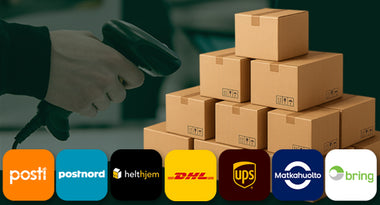
All your carriers in one place. Bring, PostNord Norway, Helthjem, DB Schenker, DHL Express, FedEx, and UPS are all supported. Connect your carrier accounts once and select the right service at fulfillment without switching between portals.
Automatic customs documents. For every international shipment — which for Norwegian merchants means almost all non-domestic orders — Packrooster generates the required customs declarations automatically with the correct carrier-specific format. It supports electronic/paperless trade where carriers accept it, eliminating the manual printing and physical attachment of customs forms to every parcel.
Shipping labels and bulk fulfillment. Print labels directly from your Shopify order view, individually or in bulk. Packrooster's barcode scan-to-fulfill workflow lets warehouse staff validate order contents and generate a label in one step, which significantly speeds up packing during busy periods.
Return labels. Generate return labels automatically alongside the outbound label, or on demand when a customer requests a return. For Norwegian merchants selling to Swedish, Finnish, and EU customers — who expect easy returns — this reduces both fulfillment overhead and support volume.
Checkout carrier control. Configure exactly which shipping options appear to which customers at checkout, based on destination, postal code, or product rules. Norwegian customers can see Bring pickup points and Helthjem home delivery. Swedish customers see PostNord or Bring Nordic options. EU customers see appropriate EU-side delivery methods. All managed from one place in Shopify.
VAT ID and customs code management. Packrooster supports assignment of EORI, IOSS, and other customs handling codes per shipping origin and destination — important for Norwegian merchants managing VAT obligations across multiple markets.
Learn more about Packrooster →
Frequently asked questions
Do I need customs documents to ship from Norway to Sweden? Yes. Despite the shared border and close trade relationship, Norway is outside the EU Customs Union. Every commercial shipment from Norway to Sweden — or to any EU country — requires a customs declaration (CN22 or CN23), a commercial invoice, and correct HS codes. This is the single most important compliance point for Norwegian e-commerce merchants shipping internationally.
How long does standard shipping from Norway to Germany take? With DHL Express or DB Schenker, standard parcels from Norway to Germany typically take 3–5 business days, including customs processing. Bring's Express International services can reach 2–3 days. Build in extra buffer for the first few weeks after introducing a new carrier or route, as customs clearance timelines can vary.
What is the best carrier for domestic Norwegian e-commerce? Bring is the natural starting point for most Norwegian Shopify merchants — nationwide coverage, including remote areas, and a range of services from pickup point delivery to home delivery and express. For stores where urban customer delivery experience is a priority, adding Helthjem for home delivery gives you a complementary option with strong consumer-facing features.
How does Helthjem compare to Bring for Norwegian home delivery? Bring's strength is nationwide reach and breadth of service — you can reach virtually every address in Norway via Bring. Helthjem's strength is the home delivery experience specifically: next-morning delivery to residential addresses, convenient delivery windows, and strong tracking. For urban customers in major Norwegian cities, Helthjem often delivers a better consumer experience. For rural or remote addresses, Bring is the more reliable choice.
What does Norwegian export customs involve in practice? For most Shopify merchants, export customs from Norway means completing the customs declaration fields when booking a shipment — declaring the goods value, HS code, and description. The carrier's booking system (or Packrooster, if you're using it) generates the required CN22/CN23 forms automatically. For higher-value commercial shipments, you may also need an export declaration filed with Tollvesenet (Norwegian Customs) — typically required for goods above NOK 5,000 in value. Your carrier or freight forwarder can advise on threshold requirements for specific routes.
Is Bring the same as Posten Norge? Bring is the commercial logistics and parcel brand operating under the Posten Norge group. Posten Norge (Norway Post) handles domestic letter and parcel delivery under the Posten brand for consumers, while Bring is the brand for e-commerce and business logistics, including international services. When you connect Bring through Packrooster, you're connecting to Posten Norge's commercial logistics infrastructure.
What happens if my parcel gets stuck at Norwegian customs? Most customs delays are caused by missing or incorrect documentation — wrong HS codes, missing commercial invoice, or incorrect declared values. Having Packrooster generate your customs documents automatically reduces this risk by ensuring carrier-specific formatting and required fields are populated correctly. If a shipment does get held, the receiving customs authority typically contacts either the recipient or the importer of record. For B2C shipments, this often means the end customer has to take action — which is a poor experience. Correct documentation on departure is the best preventive measure.
Do I need an EORI number to ship commercially from Norway? Yes, for commercial cross-border shipments. Norwegian EORI numbers follow the format NO + your organization number + MVA (e.g. NO123456789MVA). You register through Tollvesenet. If you're only sending personal gifts or non-commercial items, an EORI is not required.
Summary
Norway's shipping landscape is mature and well-served, but the customs dimension makes it fundamentally different from operating inside the EU. Bring provides the domestic and Nordic backbone. Helthjem and PostNord add last-mile depth for consumer deliveries. DHL Express, FedEx, and UPS cover international lanes efficiently.
The main operational challenge for Norwegian Shopify merchants isn't finding good carriers — it's managing customs documentation on most international shipments, coordinating multiple carrier integrations, and keeping returns simple for customers who expect EU-standard e-commerce experiences even though they're buying from outside the EU.
If you're running a Shopify store and shipping from Norway, Packrooster connects all your carriers in one place and handles labels, customs documents, returns, and fulfillment automation — reducing the manual overhead that comes with Norway's customs position.