

One-line definition: a Shopify shipping rate is the delivery price a customer sees at checkout - it can be a flat fee, free, calculated from cart weight or value, or a carrier-calculated rate based on that specific address and parcel.
Shipping rates are where a lot of Shopify stores quietly lose money. Set them too high and customers abandon their carts. Set them too low and you eat the difference on every order. Most merchants pick a flat rate on day one, never revisit it, and never find out which of those two mistakes they're making. This guide breaks down how rates actually work on Shopify, how carriers build the price underneath them, and how the main carriers compare - so you can charge something that reflects reality instead of a number you guessed.
The four ways to set a shipping rate on Shopify
Every rate you can show at checkout is one of four types. Knowing which you're using - and which you should be using - is most of the battle.
Flat rate. One price for an order regardless of what's in it, like €5.90 anywhere in the country. Simple, predictable, and easy for customers to understand. The downside is it's a guess: some orders cost you far more to ship than the flat fee, some far less, and you're averaging across all of them.
Free shipping. Free to the customer, but never free to you - you're either absorbing the cost or building it into your product prices. It converts well, especially above a minimum order threshold ("free over €50"), which also nudges basket size up. The risk is margin erosion if you haven't done the math on what shipping actually costs you.
Weight-based or price-based rates. Tiered rules where the rate changes with cart weight or cart value - €4.90 up to 1 kg, €7.90 up to 5 kg, and so on. More accurate than a single flat rate, and available on every Shopify plan. You set the tiers manually, so they're only as good as the numbers you put in, and they don't adapt to the destination.
Carrier-calculated rates. This is third-party carrier-calculated shipping - Shopify's name for rates fed into checkout from a carrier account or a shipping app. The label is a little misleading: it describes the integration channel, not a guarantee that the price is being live-quoted from the carrier in real time. Some setups do pass true real-time quotes; many pass rates the app builds from your configured rules and carrier tables. Either way it's more granular than a blunt flat fee. On native Shopify this channel is limited to the Advanced and Plus plans (or Grow with annual billing or an added fee); a shipping app opens it on lower plans and usually adds far more flexible rate rules than native settings allow.
If you take one thing from this section: flat and free rates are fine to start, but they're averages, and averages are where margin leaks. The more closely your rates track the real drivers of cost - destination, weight, size, service - the less you're guessing.
How a carrier actually builds the rate
The number a carrier quotes isn't one price - it's a stack. Understanding the stack tells you why two similar parcels can cost very different amounts, and where you can influence it.
Every carrier rate starts with a base rate set by service level (economy vs. express) and a zone - the distance or region between you and the destination. On top of that sits weight, and here's the catch most merchants miss: carriers charge on whichever is greater, actual weight or volumetric (dimensional) weight calculated from the box size. A big, light parcel is billed on its size, not its scale weight.
Then come the surcharges - fuel, residential delivery, remote-area, handling - which stack on top and often add 30% or more to the base. These are the fees that don't show up in the headline price, and they're worth understanding in detail because they're rising fast in 2026; we cover them in our guide to hidden carrier fees.
For setting your own rates, the practical takeaway is that "what does shipping cost" has no single answer - it depends on zone, weight, size, and surcharges per order. That's exactly why carrier-calculated rates beat a flat guess, and why right-sizing your packaging is one of the few levers fully in your control.
Comparing the main carriers
There's no single "cheapest" carrier - the right one depends on your destination, parcel profile, and whether your customers want home delivery or a pickup point. Here's how the carriers most Nordic and EU Shopify stores use compare at a structural level.
| Carrier | Coverage & strength | Rate model | Pickup points | Best for |
|---|---|---|---|---|
| Posti | Domestic Finland leader; international via partners | Zone + weight; parcel-locker options | Extensive lockers & points | Finnish domestic, locker-first customers |
| PostNord | Strong across Nordics (SE/DK/NO/FI) | Zone + weight; energy surcharge applies | Wide Nordic network | Cross-Nordic domestic shipping |
| Bring (Posten) | Norway strength, broad Nordic reach | Zone + weight | Good Nordic coverage | Norway and Nordic parcels |
| Matkahuolto | Finland-wide, dense pickup network | Weight + zone | Very dense in Finland | Finnish pickup-point delivery |
| DHL Express | Global express, fast cross-border | Base + fuel surcharge (can approach ~40%) | Limited (express-focused) | Fast international, high-value |
| UPS / FedEx | Global reach, express and ground | Base + multiple surcharges, DIM weight | Limited | Worldwide express, business delivery |
| GLS / Omniva / Budbee | Regional/Baltic and last-mile specialists | Zone + weight | Varies by market | Specific regional or locker delivery |
Two things this table can't capture and you should check for your own routes: exact prices, which depend entirely on your volume, contract, and the specific weight-and-zone combination; and current surcharges, which change through the year. Treat the table as a map of strengths, then verify pricing against your actual shipping profile.
Which rate model should you use?
Match the model to your store, not to what a bigger competitor does.
If you're just starting, a weight-based rate is usually the smartest default - it's free on every plan, more accurate than a single flat fee, and it stops you badly under- or over-charging on heavy orders. Add a free-shipping threshold on top if your margins allow, because it lifts average order value.
As you grow and shipping volume climbs, more granular rate rules become worth it - whether that's carrier-calculated rates or finely tiered weight-and-zone pricing. The better your rates track real cost, the less you subsidize heavy or distant orders and the less you scare off customers on cheap, nearby ones. This matters most if you ship a wide range of parcel sizes or across multiple countries, where a single flat rate is guaranteed to be wrong for most orders.
And if a large share of your customers want a pickup point or parcel locker - the norm across much of the Nordics - your rates need to reflect that delivery option at checkout, which flat rates alone can't do.
Managing more than one carrier without the headache
Here's the practical wall most growing stores hit: getting accurate, granular rates means working across several carriers, but native Shopify won't connect the regional Nordic carriers, and managing multiple carrier accounts by hand is a real time cost.
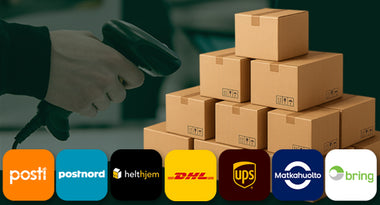
This is where a shipping app does the heavy lifting. Packrooster connects Posti, PostNord, Bring, Matkahuolto, DHL, UPS and more, brings their live pickup points and current delivery services into your Shopify checkout, and lets you build flexible rate rules across all of them from one place instead of juggling separate carrier accounts. Then, when you fulfill an order, it generates the carrier label and any customs docs in one step, and because you choose which carrier and service each order ships with, you can route each parcel by whichever option is cheapest under your own carrier agreements. If you're weighing whether that's worth it versus staying on native shipping, our comparison of Packrooster and Shopify's built-in shipping walks through exactly where the line sits.
Getting your rates right isn't a one-time setup. Revisit them whenever your product mix, carrier costs, or destinations change - which, given how surcharges are moving in 2026, is worth doing more than once a year.